Year 1
Estuarine Settings and Habitats and Gradients develop the first outcome: describe an estuarine setting with an explicit observation frame.
Marine & Environmental Sciences / BS
Study variation across an estuary through repeatable observations, sample records and comparisons made at a defined scale.
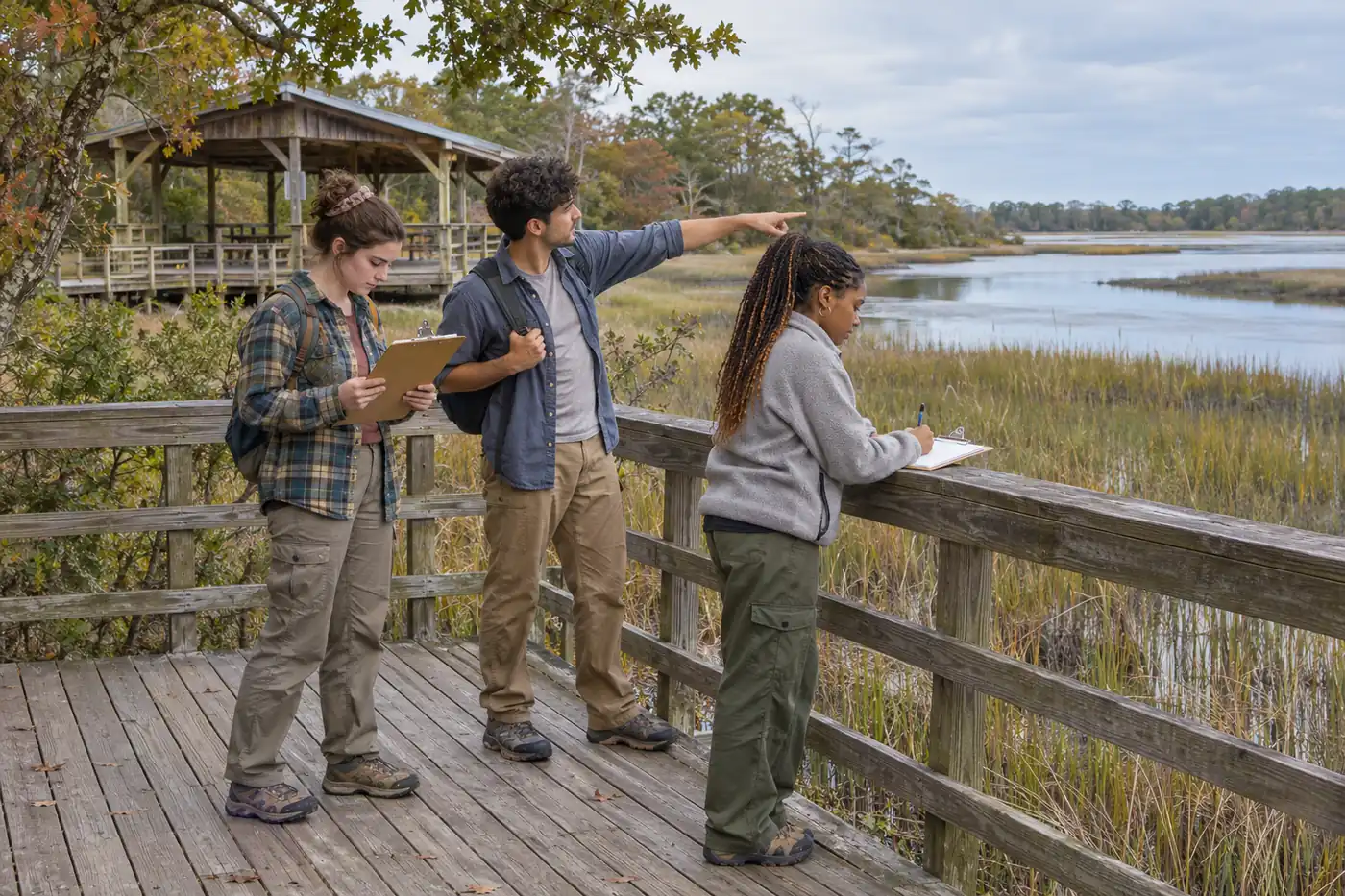
An estuary is not understood from one convenient observation. This program develops the habit of matching a comparison to its records: the setting, the observation unit, the time and the information that is missing. Supervised and supplied-data work connect ecological ideas to a defensible account.
Estuarine Settings and Habitats and Gradients develop the first outcome: describe an estuarine setting with an explicit observation frame.
Repeated Measurements and Habitat Comparison extend the work through specific tasks: A repeat-measurement notebook and summary table. A paired habitat dossier with a comparability review.
Estuary Processes Inquiry leads into Ecological Pilot Study. The reviewed pilot supplies the evidence for a narrower final proposal.
Senior Ecology Proposal and Senior Estuary Study lead to a comparative estuary study with aligned observation records, a checked dataset and a methods-and-limits presentation.
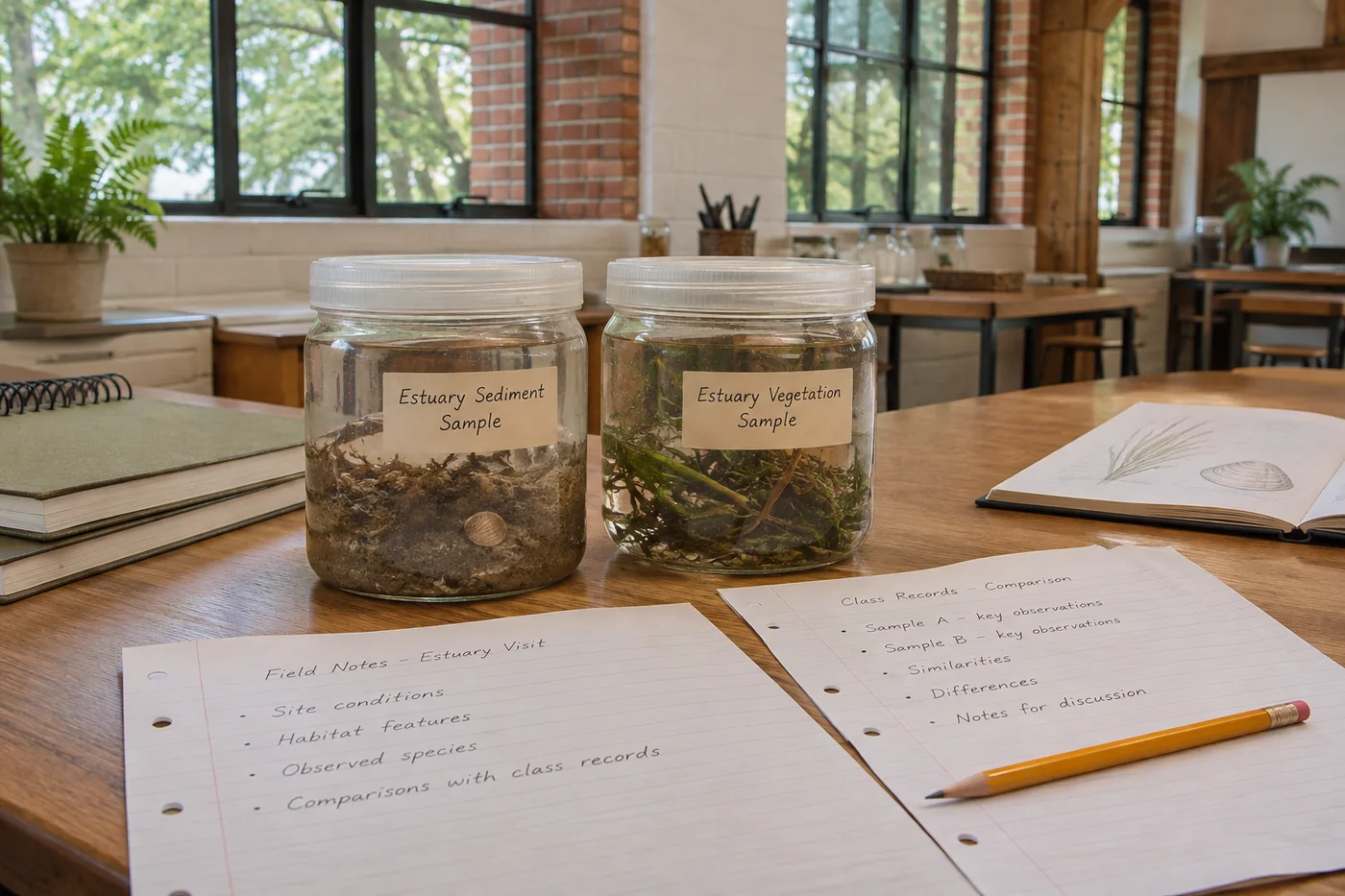
Each sample term carries 15 credits. The 120-credit degree combines major study, a science and quantitative foundation, general education and four named cross-program electives. An adviser reviews an individual plan and any alternatives.
15 semester credits
15 semester credits
15 semester credits
15 semester credits
15 semester credits
15 semester credits
15 semester credits
15 semester credits
In Estuary Processes Inquiry, a pattern in a teaching dataset becomes a question for investigation. Students compare plausible explanations and identify which next record would be needed before making a stronger claim.
Read Caleb Boone’s classroom studyOne semester credit represents approximately 45 hours of combined instruction, supervised activity and independent work over a 15-week teaching term. Six-credit integrated courses normally combine about six contact hours and twelve independent hours weekly. Laboratory and field sessions follow the approved course timetable.
The sample plans name every elective. Seminar 141 courses are introductory and open across majors in Fall or Spring. A course counts only once toward the degree, and alternative electives require adviser review of prerequisites, availability and category. BA plans include one other BA introductory 101 course and seven distinct cross-program 141 seminars.
6 credits / Fall
Describe water, vegetation and landward context from a fixed shore-based viewpoint. Students compare sketch, written note and provided teaching measurements while keeping the source of each statement visible.
Preparation: None. Assessment: A site description with a source-keyed observation sheet.
6 credits / Spring
Examine habitat descriptions and teaching datasets along a simple estuarine gradient. Students align the observation unit and timing before deciding whether the records can be compared.
Preparation: EST 101. Assessment: A gradient comparison with an alignment checklist.
6 credits / Fall
Build a repeat-observation study around one bounded environmental question. Field and indoor alternatives use the same record requirements to distinguish repeated readings from independently sampled settings.
Preparation: EST 102, CORE 140. Assessment: A repeat-measurement notebook and summary table.
6 credits / Spring
Compare two habitat descriptions using a shared observation frame and contextual sources. Students test which differences persist when effort, timing and record completeness are made comparable.
Preparation: EST 201. Assessment: A paired habitat dossier with a comparability review.
6 credits / Fall
Develop a process question from a pattern in a teaching dataset rather than assign an immediate cause. Students compare plausible explanations and propose a limited observation capable of informing the question.
Preparation: EST 202, FND 201. Assessment: A pattern-to-question brief and targeted observation design.
6 credits / Spring
Carry out a small supervised or archive-based pilot with a defined comparison. A review of incomplete entries and practical constraints becomes the basis for a revised final-year study.
Preparation: EST 301. Assessment: A pilot archive and scope-revision memorandum.
6 credits / Fall
Prepare a final comparison with explicit units, effort, source requirements and an achievable schedule. The proposal identifies the information needed before a statement about change can be supported.
Preparation: EST 302, EST 341. Assessment: A reviewed ecological study plan and data dictionary.
6 credits / Spring
Complete an ecological comparison with a checked record trail and an account of revisions. Students present what the comparison supports, what remains unresolved and how a later study could improve it.
Preparation: EST 401. Assessment: A final comparative study and methods presentation.
3 credits / Fall, Spring
Read one estuarine setting through habitat descriptions, maps and historical accounts. Open across majors, this seminar asks what each form of evidence makes visible and what falls outside its view.
Preparation: None. Assessment: A multi-source account of a simulated estuarine reach.
3 credits / Spring
Examine how observation dates, intervals and unequal effort affect an estuary comparison. Students annotate a teaching record set and revise an overextended claim to fit the information available.
Preparation: EST 141. Assessment: A comparability audit and rewritten findings paragraph.
3 credits / Spring
Study incomplete coverage, classification choices and alternative explanations in small ecological inquiries. Students make an uncertainty register that distinguishes a correctable record gap from a limit of the chosen design.
Preparation: EST 241. Assessment: An uncertainty register and prioritized revision plan.
3 credits / Spring
Prepare a concise explanation of a completed comparison for readers unfamiliar with the site. Maps, time ranges and terms are edited so the stated scope travels with the result.
Preparation: EST 341. Assessment: A public study brief and annotated evidence appendix.
3 credits / Fall, Spring
Practice separating what was noticed from the explanation added later. Short shore-based, indoor and documentary exercises share a record structure for time, setting, viewpoint and unanswered questions.
Preparation: None. Assessment: A sequence of observation entries and a comparison of two accounts.
3 credits / Fall, Spring
Turn a set of small teaching records into a readable table with identifiers, units and explicit missing values. Revisions preserve the source record and explain changes rather than silently overwriting an inconvenient entry.
Preparation: None. Assessment: A checked table, source register and correction log.
3 credits / Fall, Spring
Narrow a broad interest into a question answerable with available evidence. Compare a direct observation, a published source and a simulated teaching record before selecting the material for a limited inquiry.
Preparation: FND 101. Assessment: A question proposal and annotated source selection.
3 credits / Fall, Spring
Plan a small shared inquiry by allocating roles, time, access arrangements and record responsibilities. Students test a handover and revise the schedule when an activity or source becomes unavailable.
Preparation: FND 102. Assessment: A project agreement, schedule and reviewed handover record.
3 credits / Fall, Spring
Use units, proportions, rates and simple models to make a comparison transparent. Students state input assumptions, check dimensions and explain how a numerical choice changes the account being offered.
Preparation: None. Assessment: A checked calculation notebook with written interpretations.
3 credits / Fall, Spring
Organize small teaching datasets, describe variation and distinguish a repeated measurement from an independent observation. Emphasis falls on appropriate summaries and the questions a sample cannot resolve.
Preparation: CORE 130. Assessment: A descriptive data report and an account of sampling limits.
3 credits / Fall, Spring
Develop a claim through short passages that distinguish observation, source material and interpretation. Drafts are revised by checking what each sentence asks a reader to accept.
Preparation: None. Assessment: A sourced essay and a paragraph-level revision commentary.
3 credits / Fall, Spring
Compare public-facing texts that address the same question with different purposes. Identify the evidence, assumptions and audience behind an argument before preparing a reasoned response.
Preparation: None. Assessment: An annotated comparison and a discussion brief.
3 credits / Fall, Spring
Read selected accounts of coastal settlement, work and environmental change through the circumstances in which they were produced. Students practice separating a documented event from a later narrative about it.
Preparation: None. Assessment: A chronological source dossier with a limitations note.
3 credits / Fall, Spring
Examine how scientific questions, evidence and institutional responsibilities meet in public discussion. Cases distinguish an observation, a scientific interpretation and a decision that also involves values or resources.
Preparation: None. Assessment: A case analysis identifying the roles of evidence and judgment.
3 credits / Fall, Spring
Explore consent, attribution, representation and responsibilities to people whose work or circumstances enter an inquiry. Classroom scenarios ask students to revise a plan when its evidence does not justify the proposed use.
Preparation: CORE 101. Assessment: A research-context review and a revised information sheet.
3 credits / Fall, Spring
Compare different ways of valuing a coastal place through close reading and discussion. Students identify the assumptions of a position without treating a single concept as a complete answer to a practical problem.
Preparation: CORE 102. Assessment: A comparative essay and a structured seminar response.
3 credits / Fall, Spring
Study how costs, time, work and access shape the use of a place. Small examples make the boundary between a budget assumption, a market observation and a broader social claim explicit.
Preparation: CORE 102. Assessment: A place-based resource brief with a transparent assumption table.
3 credits / Fall, Spring
Read photographs, diagrams and displays as constructed accounts. Students compare cropping, caption, sequence and scale, then revise a visual explanation to show its source and intended meaning more clearly.
Preparation: CORE 101. Assessment: An annotated visual comparison and an edited explanatory plate.
3 credits / Fall, Spring
Compare the roles of agencies, organizations and public forums through selected documentary cases. Students trace who can advise, implement or decide, rather than assume that a published opinion has formal authority.
Preparation: CORE 102. Assessment: An institutional responsibility map supported by sources.
3 credits / Fall, Spring
Bring a substantial project into dialogue with readers outside its subject. Students edit definitions, evidence and limitations while retaining enough detail for a specialist to understand the underlying choices.
Preparation: CORE 101. Assessment: A public-facing project essay and a documented peer review.
3 credits / Fall, Spring
Introduce accounts of marine organisms through images, descriptive records and accessible scientific texts. Students compare how different source formats support identification and explanation without replacing supervised practical courses.
Preparation: None. Assessment: A contextual organism reading and image annotation set.
3 credits / Fall, Spring
Read water-related claims through sample descriptions, units and stated methods. This introductory seminar is open across majors and emphasizes interpretation of supplied records rather than unsupervised chemical procedures.
Preparation: None. Assessment: An annotated water-evidence brief with a unit review.
3 credits / Fall, Spring
Compare how different maps represent the same fictional reach through scale, symbols and purpose. Students identify what a viewer can infer from a map and which claims require another source.
Preparation: None. Assessment: An annotated comparison of three teaching maps.
3 credits / Fall, Spring
Introduce public decision-making through a fictional waterfront case with documents and competing uses. Students identify whose responsibilities and perspectives appear, and what information is missing from the record.
Preparation: None. Assessment: A contextual decision map and missing-information note.
A comparative estuary study with aligned observation records, a checked dataset and a methods-and-limits presentation.
A successful project identifies what changed after the pilot, keeps the record trail readable and makes the boundary of its conclusion clear. A supplied-data or documentary route can address an agreed learning outcome when a particular field activity is unsuitable.
A completed secondary-school record, a short academic-interest statement and readiness to work with evidence. Prior study in mathematics and a laboratory science is recommended; missing preparation is discussed individually, not represented as an automatic rejection.
Course leaders discuss accessible arrangements before scheduled activities. Shore-based, laboratory, documentary or supplied-data tasks can address defined learning outcomes; independent boat participation is not a general admission condition.
Environmental monitoring support; habitat survey support; environmental education; graduate study in ecology. These are possible fields of work or further study, not guaranteed employment or a professional license.
Estuary Ecology Program Lead
EL 04 · Estuary Learning Lab
Mon/Wed 11:00–13:00 ET